Tech Radar
Created a Backstage Tech Radar plugin with supporting automation to make technology governance visible and actionable, enabling a smooth contribution and review flow for both viewers and contributors.
Oct 2025 - Jan 2026
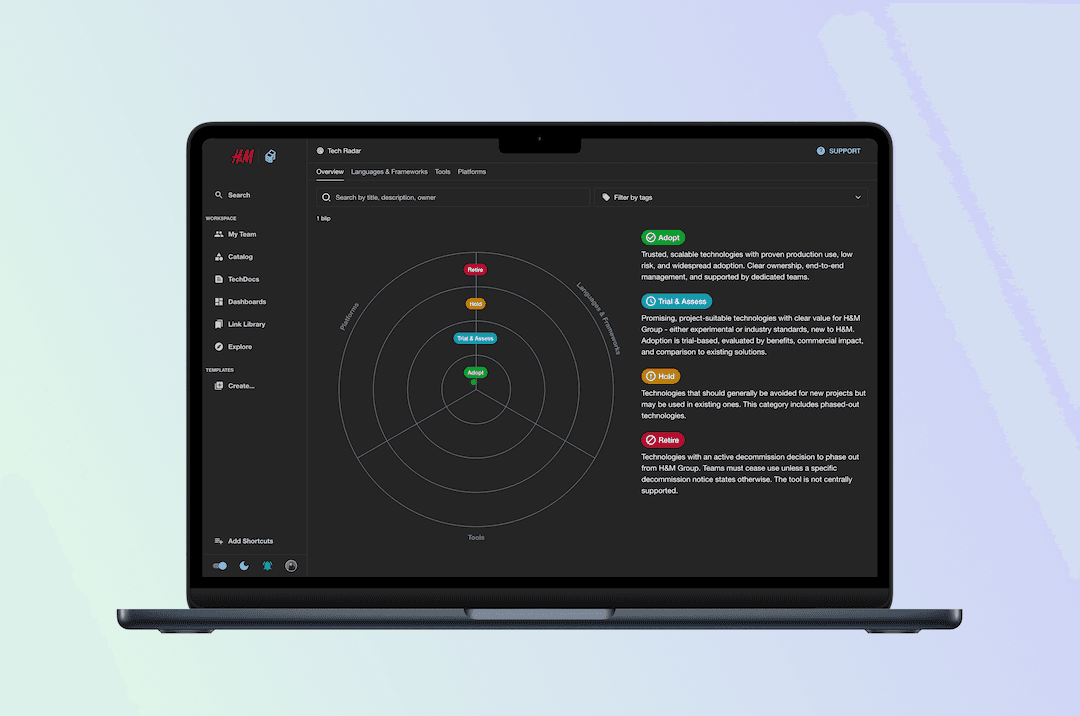
Tech Radar
The Tech Radar visualises the technologies used and recommended across the organisation. It helps teams discover, evaluate, and align on tools and platforms for their projects.
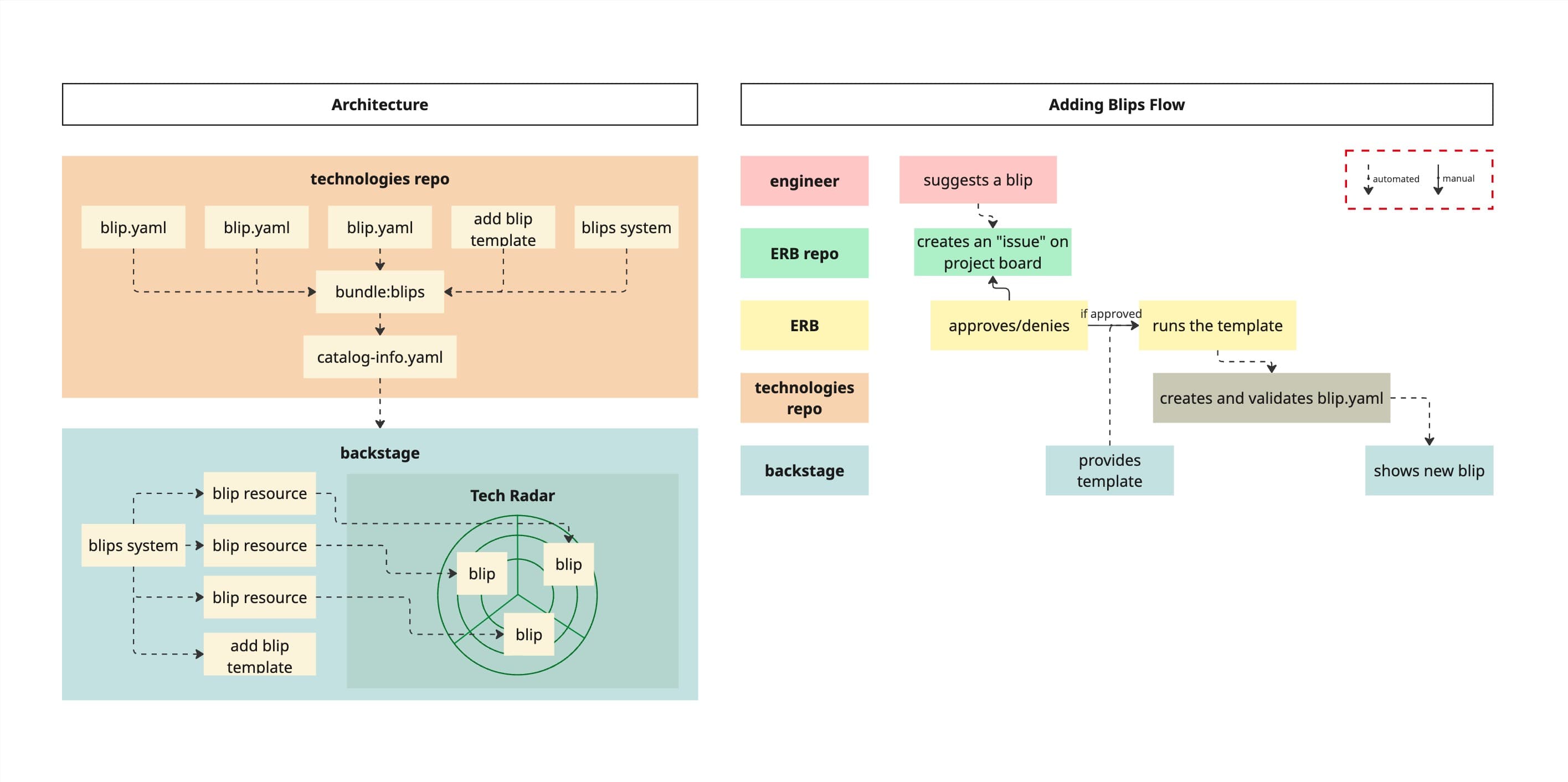
The radar aggregates blips, small YAML descriptors of technologies stored in a central technologies GitHub repository and onboarded into Backstage, the internal developer portal.
Each blip represents a technology and its current adoption recommendation.
The radar is divided into four zones:
Adopt: Technologies we have high confidence in and recommend for widespread use
Trial and Assess: Technologies worth exploring to understand their impact on the enterprise
Hold: Technologies that should be used with caution or avoided for new projects
Retire: Technologies that should be phased out
Context & Problem
The Tech Radar already existed before this project, but without a clear governance model. As a result:
No team formally owned technology decisions
Data quickly became outdated
Engineers did not know how or when to propose changes
Governance happened informally, outside the product
The lack of the governance needed to be fixed.
My Role
I designed and implemented:
The Tech Radar frontend
The contribution and governance workflow
The technical integration between GitHub, CI, and Backstage
Stakeholder alignment
I owned the work end-to-end, from problem framing to production.
Solution
Establishing ERB-Owned Governance
I introduced a new governance model where the Engineering Review Board (ERB) becomes the formal owner of the Tech Radar.
ERB now:
Reviews technology proposals
Approves or rejects changes
Acts as the long-term steward of the radar
This turned the Tech Radar from a static visualisation into a maintained decision system.
Designing the Contribution Experience
I designed the experience of adding a blip as well as the data has to come from the engineers.
The new flow:
Engineers propose technologies via the ERB’s GitHub project board
ERB reviews proposals as part of their existing governance process
Once approved, ERB opens a pull request using a structured template in the
technologiesrepository so that no coding is neededCI validates the blip and automatically updates the Tech Radar in Backstage
The process is transparent, predictable, and aligned with how engineers and ERB already work.
Redesigning the Tech Radar Experience
In parallel, I redesigned and implemented the Tech Radar interface to make technology decisions easier to understand and compare.
Key improvements:
Clearer visualisation of adoption state, reducing cognitive load when scanning the radar
Text and tag based search, allowing users to quickly find relevant technologies
Multi-blip highlighting, enabling side-by-side comparison across zones
For example, searching for "monitoring" highlights Tool 1 in Adopt and Tool 2 in Retire
Category-based views, separating technologies into Platforms, Languages & Frameworks, and Tools
These changes shifted the radar from a static overview to an interactive decision-support interface.
Impact
Tech Radar data stays up to date by design
Technology comparisons are faster and clearer
Governance is visible and documented
Engineers know exactly how to contribute
ERB retains control without additional overhead
The system is now embedded to already existing workflow.